Tuesday, December 28, 2010

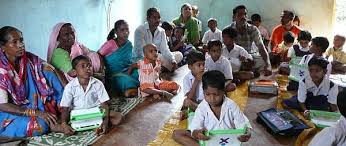
India is still struggling to raise its literacy rates

http://blog.craigdossantos.com/wp-content/uploads/2007/12/india-education.jpg
The Indian education system comprises pre-school, primary school, secondary school, higher secondary school, and higher education (graduation and post-graduation). Although primary school is compulsory, this has been difficult to achieve in practice and India is still struggling to raise its literacy rates.

Through school, students are taught a uniform set of subjects including languages, math, sciences, and social sciences. Higher education in India provides an opportunity to specialize in a field and includes technical schools (such as the Indian Institutes of Technology), colleges, and universities.

Higher education in India has evolved in distinct and divergent streams with each stream monitored by an apex body, indirectly controlled by the Ministry of Human Resource Development and funded by the state governments. The important universities are called Central Universities and these are maintained by the Union Government. The private sector also has a strong presence in Indian higher education. The Indian Institutes of Technology (IIT), National Law School, Bangalore; All India Institute of Medical Sciences; Indian School of Business , Hyderabad; and the Indian Institutes of Management (IIMs) are renowned for their superior standards of education and compete with the best in the world.

Wednesday, December 22, 2010

is india's Education sytem above US education system?

http://www.masternewmedia.org/images/school_id3688501_size420.jpg

Students in USA challenge the teachers, whereas in India, they blindly accept whatever is taught to them. Pointing out this difference, US educationist Bruce Miller said that more than half a lakh students reach the USA for higher studies each year from India, whereas less than 5,000 American nationals reach India for the same.

Yet, the system of education and pedagogy followed in India by many institutions are much above the standards of what is there in America.

Bruce Miller was presenting a paper on 'American Approach to Technical Education' during Eklavya, a two-day international seminar on innovations in pedagogical approaches to secondary, technical, vocational education and training. The seminar was organised by Toc H Institute of Science and Technology at Arakkunnam, Kochi, in association with NITTTR Chennai, Indian Academy of Applied Psychology (IAAP) and Association of British Scholars (ABS).

Friday, December 3, 2010

Education become a business.so it's lost the quality

http://www.medoasia.org/images/india.jpg
The present system of higher education does not serve the purpose for which it has been started. In general education itself has become so profitable a business that quality is lost in the increase of quantity of professional institutions with quota system and politicization adding fuel to the fire of spoil system, thereby increasing unemployment of graduates without quick relief to mitigate their sufferings in the job market of the country. So, the drawbacks of the higher education system underscore the need for reforms to make it worthwhile and beneficial to all concerned.

Competition:

Next to China,India is the most populated country in the world. Naturally there is too much rush and competition in every field. So, rush to technical and higher education has increased as scope for arts and science has become lesser and lesser due to lack of reforms and up gradation in the course structure and materials according to the developments of the world. Also, qualification in higher education gives added advantage to face successfully competition in the job market.

Purpose of Education:

All round development of personality is the purpose of education. But the present day education is neither imparting true knowledge of life, world and helping one stand on one’s own leg nor improving the talent of a student by which one can achieve laurels in the field one is interested. So, combination of arts subjects and computer science and science and humanities or literature should be introduced so that such courses could be useful for the students to do jobs after recruitment in some companies which would reduce unnecessary rush to higher education.

Right Course of Action:

In India around 240 Universities controlling somewhere 5000 colleges of various courses churning out millions of graduates
seeking jobs in vain due to lack of employability, communication skill and entrepreneurship quality. In Tamil Nadu State of India alone (from 2000 to 2006) more than 600, 000 students are hunting for jobs without hope due to political rivalries and lack of investments in job generating manufacturing units and companies. This is one side of the picture.

On the other side, all want to become Engineers or Doctors or Computer specialists in IT or Software, which is beyond the reach of many and also, all cannot shine in such a line if not suited later on. So, to overcome disappointments in the working life clear appraisal of one’s Self is necessary before pursuing a course of action.
For that not specialization but general education covering all subjects (arts, science, literature, technology, agriculture and defense studies) is very essential.

After education, tour to all the places in India and world as far as possible with the cooperation of government is necessary so that one can understand about people, culture, arts, literature, religions, technological developments and progress of human society in the world.
Basing this knowledge one should have a vision of one’s future life and work in the world and decide about the future course of action, i.e. whether to go for higher education or do job suitable to one.
Finally, based on knowledge only vision of the future life and work can be had; based on this vision only a broad ambition can be fixed for oneself; and based on this ambition only one can lead interesting life doing satisfying job to do remarkable achievements in some field in the world.
Individuality

Otherwise, the life of one will not be interesting but rather boring, monotonous and frustrating. This is mainly due to parental interference in the education of the children. Parental guidance is necessary but it should not interfere in the creativity or individuality of the students. Also, in spite of the obsolete type of education system, some are achieving wonderful things in Sports, Music, Dance, Painting, Science and Technology in the world! This is only due to the encouragement of the parents and some dedicated teachers in the educational institutions.

Higher Education:

Higher education is necessary for one to achieve excellence in the line one is best. But one should be selected for higher education on the basis of merit only. Further, fees for education in general should not be high; especially, the fees for higher studies should be within the reach of every class of people in the nation.

Standard:

In any nation education is the basic necessity for the socio-economic development of the individuals and the society. In reality only 20% of the population is educated in India. Also, only 25% of the Universities are having world class education. So, improved standard of education as first priority should be offered to the majority by the govt. authorities with sincere political will. Also, privatization of higher education is absolutely necessary in a vast country like India as government alone is helpless to do so.

Quality:

That is the way people’s quality of life can be improved and also, the nation can economically compete with the developed nations of the world. So, private educational institutions can give higher education to all irrespective of economic status of the students. As far as quality of education is concerned it should be under the control of a central institute such as All India Council for Technical Education (AICTE) and the respective Universities concerned.

World Class Education:

Indian government is not giving priority to the development of Standard in education. India should aspire for the international standard in education. To achieve that goal it should adopt uniform international syllabus in its educational institutions.

Many national universities like in the USA, UK, Australia, etc. allow studies in higher education for foreign students in their countries and through correspondence courses as well. In the same way India Universities of world class education can also offer courses of studies to foreign students taking advantage of the globalization process.

Personality Development:

Finally, education should be for the flowering of personality but not for the suppression of creativity or natural skill. In the globalized world opportunities for the educated people are naturally ample in scope. As a result business process outsourcing (BPO) activities have increased competition in the world trade leading towards the production of quality goods and their easy availability everywhere in the world market. That is the way the world can be developed for peace, prosperity and progress by able and skilful men.


Thursday, March 11, 2010

Different Education Trends in India

Education is India is no longer limited to CBSE, ICSE and state board. Gone are the days where children are exposed to nothing but the questions in books. Education has changed drastically right from the way of learning to the assignments and assessment exams. IB education is gaining ground even in the most interior parts of the world. There are a lot of reasons as to why IB education is gaining ground in India. The implementation of the IB educational system in India is the answer to all the failures of the other educational systems.

There are three main departments of education in India.

Home schooling - This is where children are exposed and encouraged to learn a variety of subjects being at home. The internet serves as the biggest source of education materials. Since education is becoming costlier these days, home schooling is preferred. But the disadvantages are that the children will not be able to analyze their potential and where they stand in the society.

Self-Study - This is another way of education which is becoming more popular in the west. The children learn things by themselves either through books or online and implement what they learn in practical life. This mode of education also stands as a major threat to the teachers who once were the only providers of information. But this form of education is not widely accepted in most of the Asian countries.

Traditional schooling - This is considered to be the most standard way of learning. But these days, due to high competition and large availability of resources, even the schools are not able to handle the students effectively. This is mainly because of the education system they follow.


Education in rural India


After India gained independence in 1947, the first Educational Minister had a vision of a country with centralized governmental control over education, and with a uniform educational system available to all children. Today, an estimated 80% of all primary education facilities for pupils up to the age of14 are government run or sponsored. Unfortunately, a shortage of resources and declining enthusiasm from the government mean the system suffers.

The pupil to teacher ratios low in most areas, especially in India’s rural centers. The lack of a solid infrastructure for training teachers leaves 40% of educators untrained. Poor facilities and a general lack of resources make things even worse. Education for children up to 14 is free, and though it is compulsory, attendance is typically low.

In recent years, public expenditure on education has decreased, despite the poor state of the system and the ever-growing need for improvement. During the same period, private expenditure on education in India has grown exponentially. Much of this additional funding is coming from Indians themselves – out of pocket spending by the country’s working class population aimed at bettering the education of their children has increased 1150% during the last decade.External funding sources also contribute to bettering the education system in India. Charitable organizations work hard to build new facilities and to improve old ones.

Thursday, March 4, 2010

Present Education System in India


India is the second largest populated country in the world and unfortunately it is nowhere near in number qualitatively. It may be again due to huge population and the type of administrative and political system we have. There is stress on cramming, memory and mugging up. One who mugs up and puts in examination paper is treated as a meritorious candidate. It does not encourage imagination, creativity and originality. There is no effective emphasis on practical aspects of life. It is mostly beset with theoretical aspects and concepts, which any one can read even without going to institutions.

School children are loaded with many books and they find it highly stressful. Education, in fact, should be filled with entertainment and fun so that student can discover the joy of learning, which is missing now. Children find it horrible to go to schools because of too much of study. Even at home children engage themselves so much on school homework. Such things do not promote the relations between parent and child at home. Inadequate infrastructure and inexperienced teaching staff are another bane. Unfortunately, in India, both the primary and secondary level education is still struggling to survive qualitatively. The views and opinions of the students are not being respected. Students are always imposed whatever is there in the textbooks resulting in lack of imagination and innovation. The secret in education lies in respecting the student. Only when students are respected and valued, they will try to think creatively, innovatively and out of the box. Students should be provided with more freedom of thought.

Kerala is the first state in India, which attained cent per cent literacy. It encouraged other states to contribute their best so as to attain total literacy. Rather Kerala has become a model state and ideal state to be emulated by the rest of the country in providing importance to education. “Education is the most powerful weapon which you can use to change the world”, said Nelson Mandela. It is very obvious that no weapon is superior to education. Apart from education, the influence of technology has brought out significant changes in the society. If technology is used in the right direction and if it is coupled with education, we can expect miracles in the society as a whole.

The growth of society solely depends on the type of educational system adopted. Education makes tremendous impact on the society. The quality of the society depends on the quality of educational system implemented. Right education makes the people build character, values, ethics, and prepares the society and country as a whole to catch up with the rest of the world. Right education is the legacy or the gift, which we pass on to our next generations.